
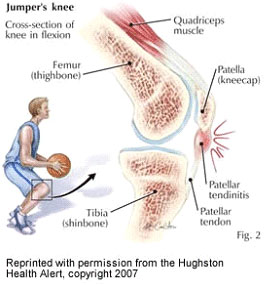
Quick post on treatment of patellar tendinopathy. This is also known as “Jumper’s Knee.” Most commonly found in those in jumping sports, such as basketball and volleyball. There was a great article just published, and I have to post so I can reference this for myself and my patients.
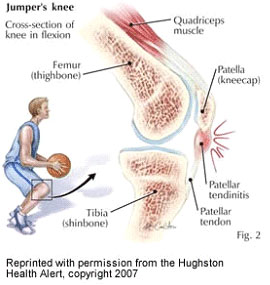
Diagnosis is generally through appropriate history of chronic increased load of the patellar tendon, usually with jumping sports and exam with point tenderness on the inferior pole of patella. This is the most common scenario. Differential diagnosis include Singling-Johanssen-Larsen apophysitis, infra patellar fat pad syndrome and patellofemoral pain syndrome.
Ultrasound can confirm and be helpful but it is not necessarily. MRI is rarely needed.
Treatment
This will focus on treatment of Patellar Tendinopathy. A great review article by Jill Cook has just been published online, open access.
Here’s the link. http://www.journalofphysiotherapy.com/article/S1836-9553(14)00091-5/fulltext
Basically:
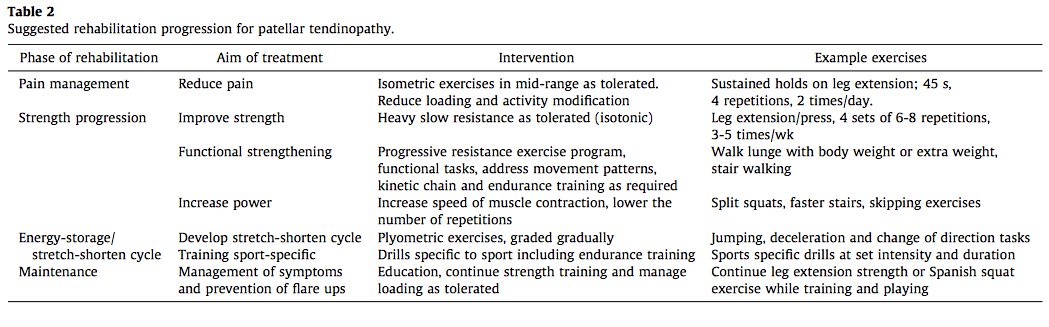
1. REDUCE PAIN–ISOMETRICS
Doesn’t have to stop completely, but load management, pain management is important to control the abuse. Although NSAIDs may be controversial, if you believe in the continuum model, in a reactive phase, there may be a role for NSAIDs in the pain control phase.
Bottom line Isometrics are important to help reduce pain.
2. STRENGTHEN–ISOTONICS/ECCENTRICS
Once the pain has been reduced and the athlete is ready to move on, then progress to strengthening phase.
Start with Isotonics/Concentrics with leg extensions and presses.
Can include eccentrics on decline board, but watch for tolerance to these painful exercises
3. FUNCTIONAL TRAINING
Low level plyometrics, progress to sport-specific drills
4. MAINTENANCE PHASE
Continue concentrics and squats for maintenance.
Here’s the suggested rehab progression, from the article.
Bottom Line, patellar tendinopathy can be common but can be treated with physio alone. While there are potential roles for PRP, sclerosing therapy and surgical treatments, all diagnosis starts with physiotherapy.
REFERENCE
1. Rudavsky A, Cook J. Physiotherapy management of patellar tendinopathy (jumper’s knee). Journal of Physiotherapy 2014;60: 122–129.


 Robert Oh, MD, MPH
This was interesting for me. I began to feel some knee pain a while ago after an aggressive game of basketball. What you described here feels a lot like it. I need to go to a therapist soon, I think, as my treatment at home hasn’t had as much improvement as I hoped. But it’s great to know a little more about what is going on in the knee and how to fix it. Thanks!
LikeLiked by 1 person
Yes, it’s very common with jumping sports like basketball and volleyball!
LikeLike